
昨夜星辰
Twin AI satellites fast-track China's global space partnerships_我的网站

A |
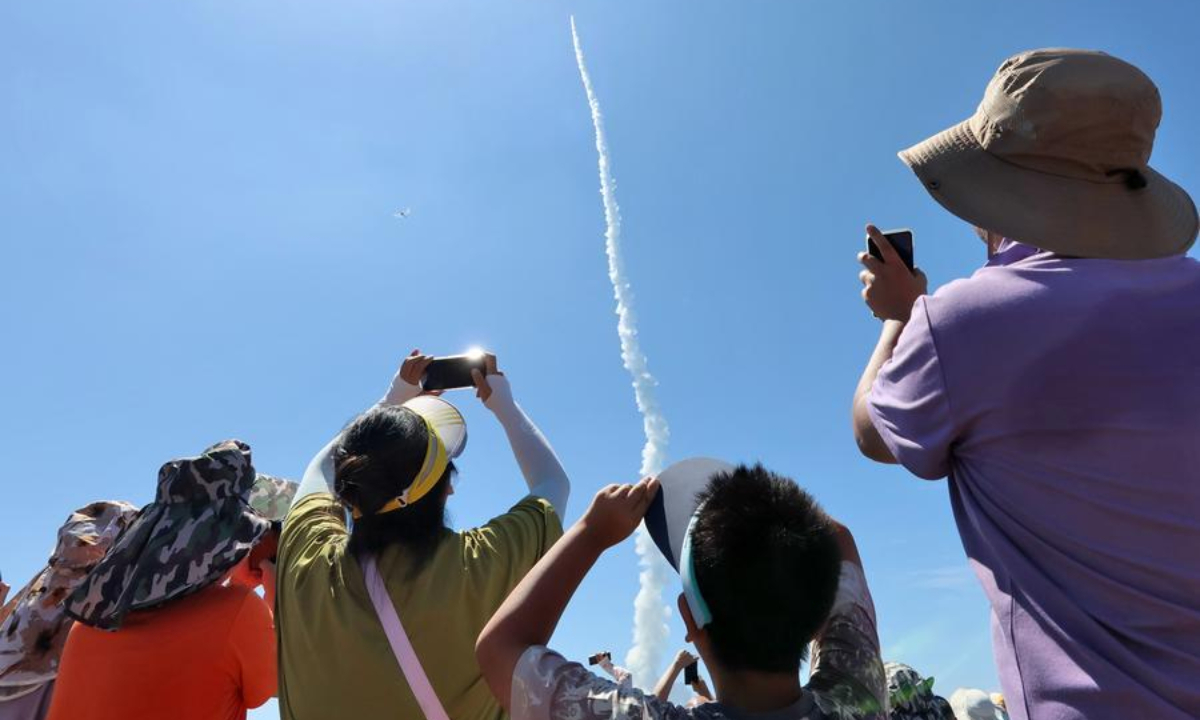
A burst of flame lit the morning sky over waters off Haiyang in east China's Shandong Province on Wednesday as a Smart Dragon-3 (SD-3) carrier rocket lifted off, drawing cheers from viewing sites along the coast.
Among the spectators were international students studying aerospace subjects in China. Aithana Perez, a Venezuelan aeronautical engineer studying space project management at Hangzhou Innovation Institute of Beihang University, said she and her classmates were excited because their studies involved spacecraft launch, design and operation.
For Marwane Oufrid, a 23-year-old Moroccan student in the same institute specializing in microsatellite technology, it was the first time he had watched a rocket launch in person.
The rocket blasted off at 10:38 a.m. (Beijing Time), delivering the Oriental Smart Eye hyperspectral satellites 01 and 02 into planned orbit.
In their respective cooperation projects with Indonesia and Uzbekistan, Satellite 01 is also known as Lampung-1 and Satellite 02 as Samarkand-2028.
Once in orbit, the satellites turned their attention back toward Earth. Lampung-1 is expected to monitor crop growth and disaster risks in Indonesia, while Samarkand-2028 is designed to support cotton cultivation and other land-monitoring applications in Uzbekistan.
Ordinary optical cameras mainly record the shape and color of objects. Hyperspectral imagers record a detailed spectrum for each image pixel, creating "spectral fingerprints" that can help determine the condition and composition of vegetation, water, soil and minerals.
These spectral "eyes" are paired with onboard AI computing modules capable of delivering up to 400 trillion operations per second. Instead of sending every raw image to the ground, the satellites can identify features, detect anomalies and extract useful information in orbit, potentially shortening delivery time from days to minutes.
Song Bingchen, co-founder of the Star.ai Spatio-temporal Intelligence Technology Co., Ltd., whose subsidiary STAR.VISION developed the satellites, compared the system to moving an AI inference platform from the ground into space.
"It changes the traditional model from transmitting images to transmitting results," Song said.
"Our satellite constellations are open to the world," Song noted, adding that the company welcomes international partners to jointly invest in, build and use the satellite networks.
In Indonesia, Lampung-1's planned applications are centered in Lampung Province on the island of Sumatra. Agriculture, forestry and fisheries accounted for 28.38 percent of the provincial economy in the third quarter of 2025. The satellite will also support marine resource management, environmental monitoring and disaster response.
Rahmat Mirzani Djausal, governor of Indonesia's Lampung Province, described the successful launch as a "historic moment" for the province.
"Cooperation with China on this satellite project is of historic and strategic significance," he said. "It marks the beginning of Lampung's transformation into a technologically advanced province."
The governor commended China's openness in sharing space technology and its commitment to long-term cooperation.
"China understands that any problems we face on one side of the world will ultimately impact the other side. Therefore, it is essential to empower regions that are left behind to make the world ultimately a better place," he said.
This cooperation also extends to people. Lampung is preparing to send over 100 young professionals to China for training in remote sensing and satellite communications, with the goal of building local capacity in satellite operation, data processing and spatial analysis.
In Uzbekistan, the applications center on cotton, grain and vegetation monitoring. Samarkand-2028 is designed to follow cotton cultivation from sowing to harvesting, while Uzbekcosmos has said hyperspectral data will also be used to produce national cotton and wheat maps.
Mukhiddin Ibragimov, deputy director of the Uzbekcosmos Agency, described the project as one of the largest international space projects in Uzbekistan's history and a milestone in its national space program.
He called the launch "a great occasion," saying it was the first time Uzbekistan had participated in an international space mission of such scale.
Ibragimov said Uzbekistan sent a technical team to China early in the project and formed a working group with Chinese specialists to develop an AI model for onboard data analysis. This model focuses on crop classification, including cotton verification, grain identification and vegetation monitoring.
The resulting data will support agriculture, water resource management, environmental protection and emergency monitoring, among other applications, he revealed.
Ibragimov said no single country can handle all space-related tasks alone.
"We believe that partnership brings value. We see that China is doing the same thing," he said, adding that Uzbekistan is exploring further satellite cooperation with China.
The projects offer a commercial example of the approach set out in China's 2021 space white paper, which called for international cooperation based on equality, mutual benefit, peaceful utilization and inclusive development.
Back in Haiyang, Oufrid said projects of this kind could give more countries an opportunity to participate in the space sector. He expressed the hope to see such cooperation happen more often and "maybe someday with Morocco as well."
。 Following Hamas' attack on Israel, the United States has sent a clear message of deterrence to prevent the conflict from spreading.To "anyone thinking of taking advantage of this situation," President Joe Biden said during an address on Tuesday, "I have one word: Don't."The rhetoric has since been repeated by others in the administration, with National Security Advisor Jake Sullivan telling reporters that they believe militia groups across the region "pose an urgent threat" and could "choose to try to exploit" the situation.On ABC News Live at 8:30 p.m. on Thursday, Oct. 12, ABC News' James Longman, Matt Gutman and Ian Pannell look at the horrendous toll from Hamas' massacre, the Israelis and Palestinians caught in the middle and what comes next."We have been sending clear warnings that doing so will result in a firm response and consequences from the United States," Sullivan said Tuesday.National Security Council spokesman John Kirby told reporters Wednesday there's a "long list of actors in the region that are hostile to Israel," including Hezbollah, the Iran-backed Lebanese militant group.The administration has also offered its full support to Israel, with Defense Secretary Lloyd Austin telling reporters in Brussels on Thursday that the U.S. is not placing conditions on the military aid it's providing to Israel. The U.S. additionally moved a carrier strike group into the eastern Mediterranean as part of its deterrence measures."We're sending a loud and clear message: The United States is ready to take action should any actor hostile to Israel consider trying to escalate or widen this war," Kirby said Wednesday.How impactful those gestures will be on the raging war remains uncertain. The U.S. has limited leverage in the region, though does need to be careful to not further escalate the conflict, foreign policy experts said. The Biden administration is also likely keen to not get heavily involved, experts said."If Hezbollah or the Islamic Revolutionary Guard Corps or some other militant group from a neighboring country decides to get involved and attack Israel at this time, I don't think the United States is going to do anything more than it's currently doing -- which is offering Israel whatever it needs to defend itself," Ralph Carter, a professor of political science at Texas Christian University, told ABC News.Biden has historically been "cautious" in sending U.S. troops into battle, Carter said. "His experience in Washington over 40 years or more suggests that once you start something like that, you have no idea where it's going to end."Kirby said Thursday that there are no active plans or intentions to send U.S. troops to join a potential ground war in Israel and Gaza. The U.S. has deployed its largest carrier group, the USS Gerald R. Ford, to the region as an act of deterrence, officials said."The United States has moved military assets in the region, but I really do find it doubtful that the Biden administration really wants to get heavily involved militarily," Russell Lucas, a professor of international relations and global studies at Michigan State University, told ABC News.Israel's powerful military is also capable of defending itself against Hamas and other militant groups, experts noted, which may limit what it needs from the U.S. and act as another deterrent."The requirements on the U.S. defense industry I think are maybe not as heavy as they might be if we were talking about a weaker ally," Adria Lawrence, the Aronson Associate Professor of International Studies and Political Science at Johns Hopkins University, said during a public briefing on the conflict.In recent days there have been some limited military engagements on Israel's northern border with Lebanon, though Hezbollah may be deterred from getting drawn into a larger conflict with Israel, experts said."They will pay dearly for entering the conflict," Lucas said. "I think most actors [in the region] know that at the end of the day, the most military-capable actor is Israel, so there is a deterrence factor."Given Israel's known military prowess, the Biden administration's rhetoric may be stronger than necessary, Lucas said."I think it's more the Biden administration is aiming especially at the domestic audience -- trying to reassert that kind of bully pulpit of the commander-in-chief role, especially in the face of perhaps critiques from the Republican Party that Biden isn't strong enough," he said.At the same time, the U.S. does need to be careful about making any threats, experts said."Words matter and if President Biden's making a commitment and making kind of an implicit threat, he needs to remember the risks that are inherent in making a red line," Lucas said. "President Obama's red line in Syria -- do not use chemical weapons -- that was then not followed up was viewed as one of Obama's biggest foreign policy failures."Sarah Parkinson, the Aronson Assistant Professor of Political Science and International Studies at JHU, said during the university's briefing that these comments by U.S. officials "will likely embolden extremists on both sides" and prolong the conflict.Following Biden's remarks, Hezbollah said they will not back down and are "ready for confrontation," while the top leader of the Islamist armed organization Houthis in Yemen said that if the U.S. intervenes militarily in Gaza, they will send munitions and fighters to support Hamas.In efforts to deescalate the conflict, the U.S. could help mobilize other countries in the region, according to James Steinberg, the dean of the School of Advanced International Studies at JHU and former Deputy Secretary of State during the Obama administration."It's not that the United States itself is going to broker a resolution of this, but it can engage others, all of whom have a stake in not seeing the situation escalate," Steinberg said during the university's briefing, noting the discussions that have been taking place between the U.S. and Saudi Arabia, the UAE and others.Secretary of State Antony Blinken told reporters Thursday at a press conference in Israel that they are working with their partners in the region to ensure "that there will not be a second front or a third front."Steinberg said a wider war "can't be ruled out," and the effectiveness of the U.S.' response to deescalate is "uncertain" -- likening it to its support of Israel in 1973 during the Yom Kippur War."Here as then, the United States has limited impact and limited leverage," he said. "Perhaps even less so today than it did in 1973."。
Current article:http://www.shangfochengcongshuaizhuang.buzz/685m/76mm3ky.html
Published on:15:56:28


1
中国苹果iPhone降价详情:高达450元2
日本一个前驻华大使把自己吹成“中国最惧怕的男人”,就他也配?3
"독도는 대한민국 고유 영토" 경북도의회, 독도수호특위 본격 가동4
辽宁开展民族团结进步创建培训 4000余名基层人员参训5
直面风险灾害,他们讲述应急一线的难忘时刻6
重磅!2026上半年RISC-V产业十大看点7
XBOX Game Pass 新增阵容:Resonance: A Plague Tale Legacy、Vapor World: Over the Mind、Blood Dungeon 等游戏即将上线8
AI时代,那些藏在安全背后的数学理论9
官方解读:2025年底 邮政快递网点禁止使用不可降解塑料包装袋10
红米红大米7号在8分36秒内售完11
福州港海铁联运再添新通道12
科学家如何科学地造火箭13
JD Gaming成功晋级无畏契约 Champions,TYLOO保留出线希望14
日本发生6.0级地震15
登录领海量好礼!《无忧》技能直接配齐,零氪开局不用苦肝!
- 随机推荐
1
官方:费利佩·查韦斯和拜仁续约至2028年,随后被租借至马格德堡2
印巴大战真泄密了?美军最强AIM-424导弹曝光,射程是霹雳-15两倍,惯性世界,原创 印巴大战真泄密了?美军最强AIM-424导弹曝光,射程是霹雳-15两倍3
Aus to expand paid parental leave4
比亚迪 × 荣耀达成深度手车互联合作,地址流转一拖即达、音乐无缝流转5
Xi calls for learning from Jiang Zemin's rock-solid political conviction6
苹果诉OpenAI未点名Jony Ive7
交通运输部:已启动首批“人工智能+交通运输”典型应用场景项目创建工作8
143国投赞成票!联大通过涉巴勒斯坦“入联”决议9
视频丨外交部:敦促有关方面停止以任何方式干预香港事务,昆明信息港,视频丨外交部:敦促有关方面停止以任何方式干预香港事务10
新型政策性金融工具方案印发 贴息成亮点11
5.2 magnitude earthquake in Nepal damages dozens of homes and causes a landslide12
国产《古神风里希》登科隆!巨物神似"金箍棒"13
Xiamen launches investigation into disinfection firm accused of using toxic pesticide at restaurants14
【透视社·反腐快报】湖北省公安厅原党委委员、副厅长、一级巡视员干永平接受审查调查15
泽连斯基承认骗了特朗普,称是被乌克兰国防部误导